M4-9c — Bicycle Detour
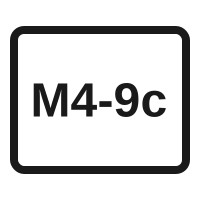
Sign Specifications
| Code | M4-9c |
|---|---|
| Name | Bicycle Detour |
| Category | Detour |
| Shape | Rectangle |
| Color | Orange / black |
| CA status | Recognized in the California MUTCD (2026) |
| MUTCD reference | § 2D.36 (MUTCD 11th Edition) |
| CA MUTCD reference | California MUTCD (2026) |
What This Sign Means
The M4-9c Bicycle Detour sign is an orange guide sign that marks a detour route. It guides traffic along an approved detour route around a closure.
California Field Use
- Posted at the closure and repeated at every decision point along the approved detour.
- Keeps diverted traffic on the intended route through the detour.
Where It Goes on a TCP
Along the detour route — at the closure point and every decision point.
MUTCD Requirements
The M4-9c Bicycle Detour is addressed under Part 6 (Temporary Traffic Control) of the MUTCD 11th Edition (MUTCD § 2D.36). Read the governing standard, guidance, option, and support text in the official MUTCD before applying it.
California Requirements
California adopts this sign through the California MUTCD, sometimes with state-specific sizing or application notes. A common conventional-road size is 30 x 24 in; larger sizes apply on expressways and freeways. Confirm the size and application for your facility against the current CA MUTCD (2026) and the Caltrans sign specifications and Standard Plans.
| Application | Standard Size |
|---|---|
| Standard | 30 x 24 in |
| Minimum | 24 x 18 in |
Common Plan Review Comments
- Detour not signed continuously at every decision point.
- Detour route not approved by the agency having jurisdiction.
- Arrow direction ambiguous or conflicting.
Compliance Notes
- Route signed continuously; no gaps at turns.
- Arrows match the approved route.
Related Signs
Related Compliance Topics
Learn more in Lane Closures and Detours.
This is an educational reference only. Always verify sign selection, size, placement, and application against the current CA MUTCD 2026, Caltrans sign specifications, Standard Plans, project documents, and the reviewing agency's requirements.