W20-8 — Stop / Slow Paddle
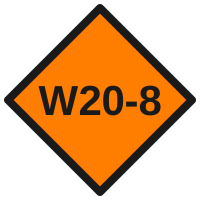
Sign Specifications
| Code | W20-8 |
|---|---|
| Name | Stop / Slow Paddle |
| Category | TTC Warning |
| Shape | Diamond |
| Color | Orange / black |
| CA status | Recognized in the California MUTCD (2026) |
| MUTCD reference | § 6F.03 (MUTCD 11th Edition) |
| CA MUTCD reference | California MUTCD (2026) |
What This Sign Means
The W20-8 Stop / Slow Paddle sign is a fluorescent-orange diamond with a black symbol or legend. As a temporary traffic control device it gives advance warning of stop / slow paddle conditions so drivers can slow down and stay alert through the work area.
California Field Use
- Posted in the advance-warning area of a California TTC zone to warn drivers of stop / slow paddle.
- Used on lane closures, shoulder work, and mobile operations as called for on the traffic control plan.
- Mounted on portable sign stands for short-duration work or on posts for longer setups.
- Removed or covered when the condition it warns of is not present.
Where It Goes on a TCP
Advance-warning area — upstream of the work, where drivers first need to react.
MUTCD Requirements
The W20-8 Stop / Slow Paddle is addressed under Part 6 (Temporary Traffic Control) of the MUTCD 11th Edition (MUTCD § 6F.03). Read the governing standard, guidance, option, and support text in the official MUTCD before applying it.
California Requirements
California adopts this sign through the California MUTCD, sometimes with state-specific sizing or application notes. A common conventional-road size is 48 x 48 in; larger sizes apply on expressways and freeways. Confirm the size and application for your facility against the current CA MUTCD (2026) and the Caltrans sign specifications and Standard Plans.
| Application | Standard Size |
|---|---|
| Conventional Road | 48 x 48 in |
| Expressway | 48 x 48 in |
| Freeway | 48 x 48 in |
| Minimum | 36 x 36 in |
Common Plan Review Comments
- Sign missing from the advance-warning area or spaced too close for the approach speed.
- Orange sheeting/retroreflectivity not specified for night work.
- Sign left in place when the condition is not present.
- Wrong sign selected for the actual field condition.
Compliance Notes
- Right sign, right place, right sheeting for day/night.
- Mounting height and lateral offset meet the standard.
- Sign condition is clean and legible; remove/cover when not needed.
Related Signs
Related Compliance Topics
Learn more in Temporary Traffic Control.
This is an educational reference only. Always verify sign selection, size, placement, and application against the current CA MUTCD 2026, Caltrans sign specifications, Standard Plans, project documents, and the reviewing agency's requirements.